How Handy Homeowners Can Insulate Their Walls

Here are two definitions used in this article. The “R-value” of a wall or a sheet of insulation is its ability to resist heat flowing through it, due to the reflection of heat radiation and also the conduction through it. It does not indicate how much energy is lost due to air leaking through the wall. Dead air insulation is a space where air is trapped. When heat energy passes through this space, the space provides insulation, because heat is not conducted through air as through solid materials, and because the surfaces on either side of the space effectively resist heat transfer by radiation.

Brick Veneer Walls

Brick veneer walls have one layer of brick covering a framed wall. Presumably all brick homes built in the past 100 years have one layer. Prior to that, many homes had two layers of brick and no wooden framing.

If your walls are brick veneer, do not fill the space behind the bricks with insulation because this drains away water that condenses after contacting cold bricks in winter. In summer, moisture or rain water entering the home through the bricks drains through the gap.

Solid Masonry Walls

If your walls are brick, block or stone with no wooden framing, there are several ways that a do-it-yourselfer can add insulation to the walls.

A. If the tops of the walls are accessible from the attic, there should be a space between the plaster (the inside surface of the walls) and the bricks or blocks. You can pour in vermiculate or perlite insulation balls. If you have block walls you can pour the balls into the walls through the holes in the blocks. If your home is two or three stories, you can only insulate the top story with insulation balls for any of these types of walls.

B. If your walls are brick with no frame, there may be a gap between two walls of brick. This insulates the house and also drains water that seeps in to prevent it from damaging the plaster during a rain. The gap can be filled with liquid foam insulation by an insulation contractor by drilling holes between the bricks of the outer wall and shooting in insulation in liquid form. It is hard to estimate the increase in R-value because the gap that would be filled is dead air insulation, but the increase in R-value will be much less than the R-value of that thickness of insulating foam.

C. If your walls are solid masonry and your climate is very cold, you could install siding with insulation sheathing behind it. Your energy savings would not be enough to justify the cost, but if your walls are unattractive, it could significantly increase the property value of your home. Aluminum siding may be the easiest type to install, and this can be done by handy do-it-yourselfers. Other types are more difficult, and some types should only be installed by “factory-trained” installers. See DIY Wall Insulation for more about different types of siding.

Frame Walls with No Insulation
To check if your walls have insulation, touch the walls on a very cold or very hot day. If they feel cold or hot they are not insulated. To be certain, remove a switch plate cover and look in the wall using a flashlight.

If you have frame walls with no insulation, as a do-it-yourselfer, you could fill the walls with loose fill cellulose insulation, which is made from shredded paper, treated with fire retardant. A do-it-yourselfer could also fill frame walls with loose fill mineral wool insulation. This is made from rock or slag. The only other option is to hire a contractor to spray in foam insulation.

Three Types of Insulation Used to Fill Walls

Type 1. Loose fill cellulose insulation is made from shredded paper, treated with fire retardant. Blowing it in can be a do-it-yourself project if you can rent a blower. The only part of the project that some homeowners could not do is repairing the 3” diameter holes in the wall that they would cut to blow in the insulation, but you could hire a painter for this. You can rent a cellulose insulation blower from a hardware store or rental store and buy the insulation at a home center.

Frame walls with wood siding and no insulation behind the siding (insulation sheathing) and no insulation in the walls typically have an R-value of about R-5 or R-6. If filled with loose fill cellulose insulation they are typically about R-11 or R-12, which is similar to walls with fiberglass batt insulation, which is in almost all homes built for many decades.
To put in loose fill cellulose insulation, cut one or two 3” diameter holes every 16” horizontally, stick the tube into each hole and blow in the cellulose. Watch a DIY video on insulating your walls with loose fill cellulose insulation.

Loose fill cellulose insulation has several problems. In very cold climates, filling the walls with any type of loose fill insulation could cause the walls to become damp inside from condensation because warm air escaping through the inner walls condenses when it contacts cold outer walls. This is because a vapor barrier cannot be inserted into the walls, which is done when walls are built. Another problem with loose fill cellulose insulation is that some fire retardants which have been used lost some of their effectiveness over the years.

Type 2. Mineral wool loose fill insulation is made from rock or slag. It is used because it is more fire-resistant than cellulose. It is much less popular than loose fill cellulose, presumably because it is more expensive and has a lower R-value. It can be put in by a do-it-yourselfer using the same equipment and methods as loose fill cellulose.

Type 3. Foam insulation can be sprayed in by an insulation contractor. It is recommended in very cold climates, because air cannot pass through it and condense to leave vapor in the walls. It is very expensive, and is only cost-effective in very cold climates. The contractor drills one or two small holes every 16” and sprays in the insulation

How to Insulate Wood Siding in Poor Condition

If you have wood siding that is making your home unsightly, you could lower your utility bills by covering it or replacing it with attractive insulating siding. This can be a do-it yourself project if you use aluminum siding. Other types are harder to install, and some types cannot be installed by do-it-yourselfers.

Insulating siding can be either aluminum siding with foam insulation bonded to it, or siding installed over insulation sheathing. If you install new siding over old siding, air trapped between the two will be “dead air insulation, which adds much insulation value if the siding behind it is fairly air-tight.

Removing and replacing your wood siding allows you to use thick, high R-value rigid foam insulation sheathing. The best is 1” thick and made of polyisocyanurate, with a reflective surface on one side to reflect heat. Removing your siding to install thinner, less expensive insulation sheathing may give you no better than covering over the old siding if the old siding is clapboard, because clapboard has air spaces in front of it when covered by insulation sheathing.

If you are installing new siding over the old, use 3/8” rigid foam insulated “fanfold” underlayment insulation, with a reflective surface, because this is the thickest available.

Energy Tips for Using Fans

1. Hang outdoor thermometers outside one or two windows on each floor. Then, you can tell at a glance when the outside air is cooler than the air in your home, and open windows, turn off the air conditioning, and put fans in or next to the windows.

You could, instead, mount a thermometer inside which has an inside and an outside temperature sensor. Do not mount the outdoor sensor where it will be in direct sunlight.

2. Run window fans and stand fans next to open windows all night long whenever weather permits. You will need less air conditioning the next day because much heat energy will have radiated out of the walls and floors of your home.

3. Set large, portable fans all over your home. This will make it convenient to move one to any location, so you use them often. See, Use All Types of Fans and Turn Off Your A/C.

4. On cool evenings, use a box fan or window fan in a window near where you are sitting, or place a stand fan next to the window. It will cool you with a breeze and also lower the temperature in your home.

5. Install ceiling fans in the living room, the sun room and the bedrooms, if you would use less air conditioning. In rooms over 18’ long, two ceiling fans could be installed. If your ceilings are high, hanging ceiling fans from down rods will make them more effective.

In the bedrooms, if you install ceiling fans that are larger than recommended, you can run them at a lower speed for quieter operation.

6. Check that your ceiling fans rotate counter clockwise in the cooling season. Ceiling fans rotate this way to push air downward to create breeze. If a fan is rotating clockwise in the cooling season, reverse its direction by sliding a switch on the side of the fan or by pressing the “reverse” button on the remote. If the fan has neither of these it may have a switch on its top surface or you may have to remove a small cover plate on the bottom to access the switch.

7. Don’t leave ceiling fans turned on when not in the room. Their motors create heat, slightly raising the room’s temperature. Several ceiling fans can raise the home’s temperature by 1º, which increases the cost of air conditioning. Also, this will waste electricity.

8. If a fan is using incandescent bulbs, replace them with 13-watt mini-CFL bulbs or LED bulbs. Incandescent bulbs create heat and waste electricity.

9. If your bedroom ceiling fan runs all night because you don’t like to get up to turn it off, buy a “ceiling fan remote kit” to convert the fan to remote control. They are sold at many stores where fans are sold.

10. If a fan is higher than about 8 ft. above the floor, replace the downrod to lower the fan to about 7 ft. The fan will become more effective in the summer, but almost useless in the winter. Downrods are sold wherever fans are sold, and all are the same diameter as on fans, (½” I.D.). Most fans are installed with short downrods, which can always be replaced, but there must be extra wire in the electric box.

11. Mount one or two 60” or 52” ceiling fans in your porch if you would spend more time there and turn off your air conditioning. turned off. They must be water proof.

12. If you have a ceiling fan in a large room, which is less than about 52”, replace it with a 52” fan. If it is smaller than this you may be using more air conditioning than necessary. Also, 52” fans can have very different maximum airflows, depending on the pitch of their blades, the number of blades, etc. The maximum airflows are given in CFM’s on the box or website.  

Lower Your Utility Bills with Insulating Window Film

Insulating window film is thin, plastic film which you stick onto the glass. Some types are glued on, but most stick on by “static cling”. It is often confused with “window kit shrink film”, which is clear plastic film insulation that is mounted to the window frame and heated with a hair dryer to make it clear. There are different types with different advantages and disadvantages.

Heat energy flows into and out of a house through the window panes as two types of radiation: ultraviolet (UV), which is the higher frequency radiation, and infrared, which is a lower frequency radiation. The heat from the sun enters as UV radiation. It enters as direct sunlight and also as indirect sunlight. On a bright day much enters as indirect sunlight.

Heat flows through the panes in either direction as infrared radiation when the temperature is higher on one side of the glass than on the other side. It leaves the house as infrared radiation on cold days and enters on hot days.

Reflective Window Film

Reflective window film is designed to block UV radiation in the hot months to keep out the heat. There are two kinds of reflective window film: “mirror reflective” and “tinted reflective”. Mirror reflective film looks like a mirror from outdoors, but is practically transparent from inside the house. It is the best way to block UV radiation and keep the home cooler in the summer. Mount it only on the windows that the sun shines directly through. It works better on east- and west-facing walls, because the sun’s rays enter at lower angles.

Tinted reflective window film darkens the windows to increase the light that enters the home. Tinted vehicle windows have reflective windows film. Companies offer a wide range, from film that reflects very little light and is virtually invisible from inside, to film that makes the home significantly darker. Some hardware stores offer a range of these films, but only one may be in the store, the others must be ordered.

Heat Control Window Film

The label “Heat Control Window Film” is given to window film that is reflective to block UV radiation and in addition has a “low-E coating” to reduce infrared radiation. UV radiation mainly enters the house, increasing the home’s need for cooling in the summer, whereas, infrared radiation mainly transfers heat out of the house in the winter, increasing the need for heating.

Heat control window film is labeled in different ways. It may be labeled, “blocks UV rays” or “low-E coating to retain winter heat”.

Low-E coating is a thin layer of very tiny metal particles which blocks infrared radiation. Infrared radiation, as explained above, transfers energy from the warmer to the cooler side of a window. Low-E stands for “low thermal emissivity”. Emissivity is the measure of how much infrared radiation will pass through it, averaging about 30% for window films.

Heat control window films are classified by their “clarity”. Those with the minimum clarity provide the most superior insulation, but allow the least light to enter the house. They are mounted by static cling, so one can easily replace them if they make any rooms too dark. The websites of some window film manufacturers show how much a room is darkened by each of their films and give their emissivities, but they do not take into account how much sunlight enters the rooms. Some companies require that their installers put on their films.

Which Type Should You Install On Double-Glazed Windows?

Reflective window film, since it reflects sunlight, is quite effective at lowering air conditioning costs in homes with double-glazed windows. However, heat control window film is much less effective with double-glazed windows because these windows have been designed to block infrared radiation. The inner and outer surfacess of each piece of glass reflect it, and more importantly, the gas trapped between the panes.

For many other ways to insulate your windows, read How to Insulate Windows.

How to Save Electricity When Using a Heat Pump

If you heat and cool your house with a central heat pump, these energy tips will help you to greatly reduce your electric costs. To learn ways to save energy when purchasing a heat pump, see Heat Pump Efficiency.

  • Hire an HVAC contractor to do a tune-up and inspection every one or two years. The six inspections below will maximize your heat pump’s efficiency:

  1. Check if the system has lost refrigerant. If some is lost the system will be less efficient.
  2. Inspect the visible ductwork for air leaks. Leaks lower the system’s efficiency.
  3. Check the system for peak efficiency and adjust it if necessary.
  4. Inspect the indoor motor wheel and motor and record the amp draw (how much electricity it uses). If this is too high the system is wasting electricity.
  5. Check for sounds which would occur when the motor bearings need to be replaced.
  6. Calibrate the thermostat.
  • To improve the efficiency of the system, you can do several annual maintenance procedures yourself. Those which you can do are given in the owner’s manual. If you no longer have the manual, try to find it on the manufacturer’s website or order it from the manufacturer.
  • Replace the filter the first week of each month. A dirty filter lowers the airflow through the system, reducing its efficiency.
  • Do not set back the thermostat at night in the heating season unless you have a thermostat designed for heat pump set-back. Setting it back with a conventional thermostat will result in higher energy consumption.
  • If the outdoor unit is closely surrounded by shrubbery, replant it 2 to 3 ft. away. Tall bushes trap warm air, reducing the coils’ ability to release heat in the summer.
  • If high winds are common, plant tall bushes to block the outdoor unit from wind. High winds can reduce efficiency by allowing frost to form.
  • Check if your heat pump cycles on and off too often in the summer. If it does, it is wasting energy. They normally cycle about every 20 minutes when the outdoor temperature is 95 to 105 degrees. If it cycles more often the thermostat may not be working correctly or the filter is very dirty or the blower is malfunctioning.
  • Buy a programmable thermostat designed for heat pumps.
  • Do not allow water from the roof to run onto the outdoor unit. This could cause ice build-up.
  • Check that the outdoor unit is perfectly horizontal.

How to Seal the Gap Under a Basement Door

If the floor beneath your basement door is concrete, there may be no threshold below the door. Often there was one originally, but the screws that mounted it have rusted away. It may not have been replaced because the people living there were unable to mount one to concrete.

Do not mount a door sweep where there is no threshold because it would wear out soon from dragging across the floor.

The Air Pressure is Minimum at the Basement Floor

When your central heating is on, a gap under the basement door lets in more cold air per sq. in. than anywhere else in the house. This is due to the “chimney effect”. When air in the house is being heated it expands, becomes lighter and rises to the attic. There it leaves the house through the attic vents.

As a result of it moving up, the air pressure becomes lower in the basement and on the first floor. The air pressure is different at each elevation of the house, highest at the top and lowest at the basement floor. Here, it is significantly lower than the outdoor air pressure, so air is drawn in forcefully at any opening.

Mount a Threshold Beneath the Door

The only long-lasting way to seal a gap under a basement door is to install an oak or aluminum threshold. Aluminum is more durable because the location is slightly damp, so oak may eventually deteriorate. Saw off the bottom of the door to leave a 1/4″ gap between the door and the threshold. Screw a door sweep onto the door to seal the gap. It will close tightly against the threshold and it can be easily replaced.

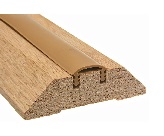
There are oak and aluminum thresholds with vinyl inserts mounted above them that are designed to close the gap beneath the door, but they have several problems. The door’s bottom surface must be perfectly flat and smooth or there will be air leaks. Also, it is possible that the bulb could wear out and be no longer available or very hard to find.

Oak Threshold with Vinyl Insert

Take down the door before cutting it because it is hard to cut it neatly if it is hanging.

Mount the Threshold

Don’t mount it with masonry nails because there are pebbles in the concrete which would stop the nails. It is best to use a small hammer drill to make the holes, and insert wall anchors. Then, screw the threshold into the wall anchors. Hammer drills “hammer” while drilling to break small stones. Use large plastic anchors or thin lead anchors. If you don’t have a wall anchor you can buy an inexpensive “powder actuated tool”. These shoot special nails into concrete using gunpowder, and are sold at home centers. Use medium charges when using an oak threshold so you don’t crack it. If the nails don’t enter far enough you can drive them in farther using a framing hammer (a very large hammer) or a small sledge hammer.

Powder Actuated Tool

Do not drill the holes or drive the nails at the centerline of an oak threshold, but rather off-set them slightly (see drawing below). If the screws are put in near the centerline the threshold could break.

Screw Offset from Centerline

Before mounting it, apply polyurethane construction adhesive. This can only be used if the floor is very dry.

For many more ways to insulate doors, see How to Insulate Doors

Design a site like this with WordPress.com
Get started