If the floor beneath your basement door is concrete, there may be no threshold below the door. Often there was one originally, but the screws that mounted it have rusted away. It may not have been replaced because the people living there were unable to mount one to concrete.
Do not mount a door sweep where there is no threshold because it would wear out soon from dragging across the floor.
The Air Pressure is Minimum at the Basement Floor
When your central heating is on, a gap under the basement door lets in more cold air per sq. in. than anywhere else in the house. This is due to the “chimney effect”. When air in the house is being heated it expands, becomes lighter and rises to the attic. There it leaves the house through the attic vents.
As a result of it moving up, the air pressure becomes lower in the basement and on the first floor. The air pressure is different at each elevation of the house, highest at the top and lowest at the basement floor. Here, it is significantly lower than the outdoor air pressure, so air is drawn in forcefully at any opening.
Mount a Threshold Beneath the Door
The only long-lasting way to seal a gap under a basement door is to install an oak or aluminum threshold. Aluminum is more durable because the location is slightly damp, so oak may eventually deteriorate. Saw off the bottom of the door to leave a 1/4″ gap between the door and the threshold. Screw a door sweep onto the door to seal the gap. It will close tightly against the threshold and it can be easily replaced.
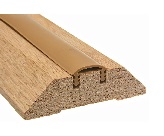
There are oak and aluminum thresholds with vinyl inserts mounted above them that are designed to close the gap beneath the door, but they have several problems. The door’s bottom surface must be perfectly flat and smooth or there will be air leaks. Also, it is possible that the bulb could wear out and be no longer available or very hard to find.
Take down the door before cutting it because it is hard to cut it neatly if it is hanging.
Mount the Threshold
Don’t mount it with masonry nails because there are pebbles in the concrete which would stop the nails. It is best to use a small hammer drill to make the holes, and insert wall anchors. Then, screw the threshold into the wall anchors. Hammer drills “hammer” while drilling to break small stones. Use large plastic anchors or thin lead anchors. If you don’t have a wall anchor you can buy an inexpensive “powder actuated tool”. These shoot special nails into concrete using gunpowder, and are sold at home centers. Use medium charges when using an oak threshold so you don’t crack it. If the nails don’t enter far enough you can drive them in farther using a framing hammer (a very large hammer) or a small sledge hammer.

Do not drill the holes or drive the nails at the centerline of an oak threshold, but rather off-set them slightly (see drawing below). If the screws are put in near the centerline the threshold could break.

Before mounting it, apply polyurethane construction adhesive. This can only be used if the floor is very dry.
For many more ways to insulate doors, see How to Insulate Doors
 Lower Your Energy Bills